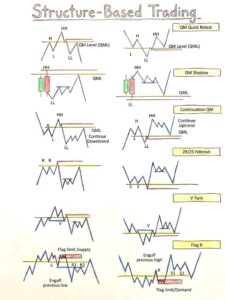
Smart Money Concepts (SMC)

Introduction:
The SMC (Smart Money Concepts) is a trading system that emphasizes how the big institutional participants in the financial markets such as banks and major investment firms like hedge funds and mutual funds, etc., operate in the market. The basic concept of SMC is that retail traders, who in a group represent a small amount of total market volume, are often on the losing end of trades primarily due to their reactions to price changes, rather than beforehand. Therefore, the institutions have an advantage over the retail “players” as their buying power allows them to move the markets when they wish to do so, as well as having the knowledge to “trap” the retail traders as they take a losing position, and then push the price in the direction they (the institutions) actuallyintended to trade to begin with. By identifying the “footprints” left behind by the glaring actions of the “big kids” on price charts, SMC aims to decode those “footprints” and provide retail traders with an opportunity to trade with the “big boys” rather than against them.
The Smart Money Concepts (SMC) originated predominantly based on the earlier Interbank Price Delivery Algorithm (IPDA) theory and got an explosive following due to the ICT (Inner Circle Trader) system, which was also rebranded and simplified by many other traders and is now commonly called SMC. Although it originated from the forex market, all of its concepts can be directly applied to trading of stocks, commodities, and indices as they all possess similar market structures and order flow dynamics.
Importance of Smart Money Concepts:
The prices in any active market do not change randomly. Price moves because there are many buyers and/or sellers that want to buy and/or sell, and they must have their trades completed. However, it is not possible for any one large institution (such as a mutual fund, pension fund, etc) to place one large buy/sell order without having massive impact on the overall market. Therefore, large institutions generally try to accumulate or distribute their positions slowly over time using various strategies to create different types of false signals to attract retail traders to provide liquidity to fill their orders. SMC gives traders a system for identifying the zones of manipulation, and the actual entry points that institutions use, as well as the general context for where price is going based on liquidity and structure instead of just relying on indicators like the RSI or MA’s.
Core Components of Smart Money Concepts (SMC) include:
1.Market Structure:
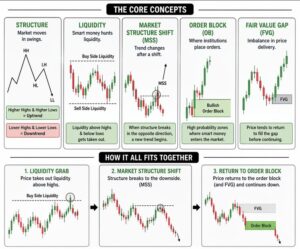
The main component or foundation of SMC is market structure. Market structure can be defined as a series of higher highs and higher lows during an uptrend, or lower highs and lower lows during a downtrend. SMC traders primarily focus on the following:
Break of Structure (BOS):

The BOS occurs in an uptrend when price breaks through prior swing highs, once this occurs it confirms the continuing trend that was established previously.
Character Change (CHoC):

The change of character occurs when the price breaks the previous structure, which was in the direction of the trend, to move in the opposite direction of the trend, and hence, may indicate the end of the previous trend. For example, if prices are trending upward and setting new highs, but then it falls below the previous high point, it is a CHoCH and is an indication that the uptrend has likely come to an end.
By analyzing market structure correctly, traders can identify the current market bias and, hence, protect themselves from trading in the opposite direction to the prevailing institutional flow.
2. Liquidity:

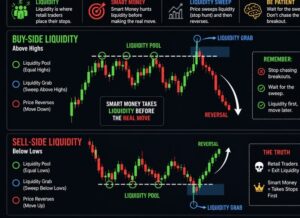
Liquidity is arguably the single most important concept in SMC. Liquidity refers to areas on the chart where a cluster of orders (Stop-loss orders and pending orders mainly) are resting. Most retail traders will put their stops just above recent swing highs and just below swing lows, and this cluster of stops is an attractive target for institutions because triggering of the stops will provide the volume for institutions to fill large orders. Some of the key liquidity concepts include:
Buy-side liquidity (BSL): BSL is located just above swing high points, where the stop loss orders of short-sellers and the pending orders of breakout buyers are located.
Sell-side liquidity (SSL): Sell-side liquidity, or SSL, are found just below swing low levels, where the stop loss orders of long position holders and the pending orders of breakout sellers are located.
Stop hunts or liquidity sweeps occur when price action rapidly moves through a particular area of liquidity to trigger said orders and then quickly moves back in the opposite direction. Many traders see this as a smart money trap designed to build a position at a good price.
Equal highs or equal lows occur when the price touches the same high or low multiple times. In these cases, institutions target the larger liquidity pool created before reversing after they have created an obvious liquidity pool. Traders who can identify the location of the resting liquidity will have an edge in determining the direction of the next true directional move. An order block is another tool to help identify areas of potential support and resistance in the market.
3. Order block :

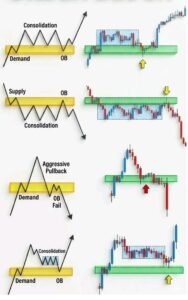
An order block is a candle (or set of candles) that marks the final area of institutional buying/selling activity prior to a large/quick occurrence of price movement. Order blocks are generally considered to be the footprints of smart money positions.
A bullish Order Block will usually be the last candle that closes lower before a bullish impulse occurs, and shows that smart money was accumulating buy trades at that level.
In SMC (Smart Money Concepts) trading, the smart money will actively sell or short the market at an artificially high price to create bearish order blocks (OBs) and phony buying imbalances (BIs) as a means of dumping their inventory. A price retrace into this bearish OB gives SMC traders the opportunity to take advantage of the OB, as it is protected by the smart money, and the SMC trader anticipates that the smart money will defend their OB.
4. Imbalance (Fair Value Gap, FVG):

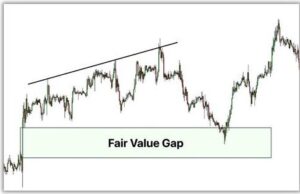
Fair Value Gap (FVG) or Imbalance basically refers to the instance when the price moves excessively fast in a single direction, leaving a visible price gap between two candle wicks on a three-candle formation. Specifically, one candle’s high does not overlap with the low of a candle formed two periods later. This is evidence that prices were traded inefficiently; either the buy or sell side was concentrated to an extent where the price does not trade in a “fair” manner through that zone.
SMC theory proposes that price will typically return to fill these gaps, or ‘rebalance’ them, prior to resuming its original direction; therefore, FVG’s are often used as entry zones, in particular, when they converge with order blocks, or another form of confluence.
5. Discount and expensive zones:

You can use the idea of worth to comprehend this as so as that SMC applies this concept as well. Organizations usually purchase at a discount and sell at a premium. A similar technique to drawing a Fibonacci retracement across a major price move divides the range in two such zones for trading purposes:
Discount area: this is the lower half of the total price swing; it may be considered a buying area by institutions.
Premium area: this is the upper half of the price movement and may be considered a selling/shorting area by institutions.
Balance: 50% of the midpoint, meaning traders find it to confirm their biases.
This framework can allow traders to avoid getting in at prices they would pay too much for or sell at prices that they would sell for less than what they want to sell for. This framework allows the trader’s entry to be closer to the price that institutions will likely find it.
6. Source and Requirement Areas:
Like order blocks, but larger and more general, are the supply and demand zones which show price has previously met with significant amounts of buying (demand), or selling (supply); each exceeded the other causing one directional movement. Thus, when the price revisits these areas, the supply and demand zones provide areas where we might expect price to react.
7. Inducement:
Inducement involves a price action that’s made to get retail traders involved in a trade ahead of where institutions are about to enter the market. Inducements generally experience the formation of a small liquidity pool prior to a large institutional order block or zone, this provides a “trap” that will be taken out and hit before the real institutional move happens. If you are aware of the presence of inducement in the market, then you will not fall into the trap of entering a trade early, getting stopped out before the true move actually takes place.
A mitigation block should be understood as having some relationship to the order block; however, whereas an order block represents the area right before a new higher high and lower low, the mitigation block can be defined as the last Opposite Candle(s) prior to a major reversal. The function of this block as explained within the context of SMC (institutions) is that this would be the area at which institutions would try to “Mitigate” or exit their losing position(s). This concept is more sophisticated and much more refined and advanced than the typical Order Block concept and therefore is usually found to be used more by advanced SMC traders to trade.
How SMC Traders Use Concept of SMC in Trading Stocks:
A standard SMC based stock market trading strategy comprises of most commonly used steps;
Identify Higher Timeframe Bias: A higher timeframe (daily/4-hour) is used as a reference to identify what the overall market structure is/has been and whether a given trend is moving in that direction. This will include identifying whether there has recently been a Shift in Market Structure or Change in Character (BOS or CHoCH).
Identify Major Liquidity Pools – i.e. swing highs, swing lows, equal highs, equal lows, etc. It is also probable that many stop-losses are clustered around these areas.
Wait for liquidity to be removed: before the SMC traders go into the trade, they stay on the sidelines until the price is able to remove retail liquidity. Once the price removes retail liquidity, it will be a confirmation sign that smart money will be on the opposing side to the retail traders.
Drop down one time frame when entering a trade: once the price has fully removed retail liquidity, SMC traders will proceed to look for a ‘change of character’ (CHoCH) on one of the two smaller timeframes (fifteen-minute and five-minute charts) to confirm the reversal of the move by identifying an order block or fair value gap (FVG) that was formed in conjunction with the liquidity removal, as an entry point for the trade.
Entries are also confirmed using premium & discount zones, where discount zones provide confirmation of long entries while premium zones confirm short entries.
Determine a Stop Loss and a Target:). A stop loss is usually set at an area near the liquidity sweep or order block, whereas a target would be the next large liquidity pool or imbalanced area.
This Top Down multiple timeframe analysis method is a major part of SMC Trading and separates SMC Trading from simple technical analysis that uses only indicators.
Advantages of SMC (Smart Money Concepts) are as follows:
1.Produces a logical, sequence-based approach to analysing price action, as opposed to purely using indicators that “lag” behind price movement.
Assists traders in not falling into the classic retail traps of executing trades in breakouts at liquidity highs or in the case of breakdowns at liquidity lows.
Provides discipline using structured, multi-step process of confirmation prior to trade entry.
It works in all markets, stocks, indices, forex, and commodities since the liquidity-based logic is the same in each of the order-driven markets.
Criticisms and Constraints :
There are several critical opinions of SMC despite its popularity; therefore, it is important to be familiar with each.
Subjectivity – The way that one trader identifies an orderblock, a liquidity zone and/or a shift in structure could very well be significantly different from the way another trader does; thus, it creates a situation where objective testing through backtesting will be difficult at best, and applying the approach in a completely consistent manner will be impossible.
Hindsight Bias – A majority of SMC patterns appear to be clearly identifiable on a historical chart in hindsight. However, the same patterns appear much more difficult to identify and trade live.
There is no official connection between institution and the retail SMC trader or “Smart Money” trader. Therefore, there is no concrete evidence to support the claim that the ideas popularize in the SMC market by retail trader are actually reflected in the trading algorithm of various bank and hedge fund. The terminology may sound good to many people, but it has yet to be officially adopted by any of the leading global financial institution.
Trader typically look for the confirmation of a trade direction by forcing SMC pattern onto chart and interpreting price action to their advantage. This leads to a situation when the chart pattern is over-fitted with the trade idea.
Takes a lot of practice and screen time. Learning SMC is mostly made up of time spent practising on charts and learning from experience, since SMC is based a lot more on the ability to visually identify patterns on charts and interpret them within the correct context, as opposed to using any form of mechanical/structured rule.
SMC in Indian Stock Market Context
SMC concepts are very much used in index trading on the two major indexes; i.e., Nifty 50 and Bank Nifty, and also on the liquid large cap stocks, as these types of stocks have sufficient volumes and institutional participation for all liquidity-based concepts to be effective and relevant. Many traders in India usually use SMC along with options trading strategies whereby they use liquidity sweeps and order blocks for their entry timing based on key support and resistance zones, especially during major events such as results season, announcements of RBI policies or any other global cues that may impact Nifty futures. However, due to the low liquidity of Indian markets in general (i.e. mid caps and small cap), as well as their susceptibility to operator-driven moves (i.e. when the entire flow into a market from an institution is not observed), the SMC concepts may provide more reliable signals to traders on indices and highly liquid large cap stocks than they do on illiquid smaller stocks.
Conclusion
The Smart Money Concept provides clear-cut structure that traders can use when analysing price changes with accompanying institutional trading patterns (eg. market structure, liquidity, order blocks, fair value gaps and premium/discount pricing). The theoretical aspect of Smart Money enables a trader to know/understand what causes prices to change either upwards or downwards, but Smart Money does not provide the trader with an automated or infallible trading system or method. Trading Smart Money successfully requires that traders devote time to learning the technique, have discipline in managing their risk, and also look at things within context and not apply strict rules with no flexibility. Therefore, if a trader is willing to commit sufficient amount of time to service this method, then they will have good supplementary trading strategy/discipline when using sound risk management strategy and understanding of the market environment as either full-time traders or as part-time